
Publications
Abstract
Through a practice-oriented study, various coincident, near-coincident, and non-coincident immersive microphone arrays were compared during drum recordings for different contemporary popular music genres. In a preliminary study, the OCT-3D, PCMA-3D, 2L-Cube, Hamasaki Square, IRT Cross, Ambisonics A-Format, and native B-Format were informally compared. This revealed that the differences among the non-coincident systems were much smaller than the differences between coincident and non-coincident systems. This led to a reduction in the number of microphone systems used for the final drum recordings.
Four microphone techniques were selected: OCT-3D, native B-Format, Ambisonics A-Format, and IRT Cross. These were compared within the context of two different songs—a soft pop song and an energetic rock song—where the drums were recorded in a dry drum booth and a large studio hall, respectively.
A listening test with a small sample group was conducted to determine which microphone technique best suited each song. Participants were also asked to identify their overall favorite without musical context, as well as to evaluate spatiality, timbre, and height perception. It was concluded that the choice of immersive microphone technique depends on the musical context.
Conclusions from more objective studies primarily focus on accurate localization, in which non-coincident systems consistently perform best. However, these studies often fail to adequately consider the musical context, where accurate localization is not always the primary concern. Additionally, it was observed that height perception in music is not solely created by speakers in the height layer.
CONCLUSION // similar to practices in stereo recording, the choice of using either a non-coincident or coincident microphone array can depend on the musical context and room acoustics
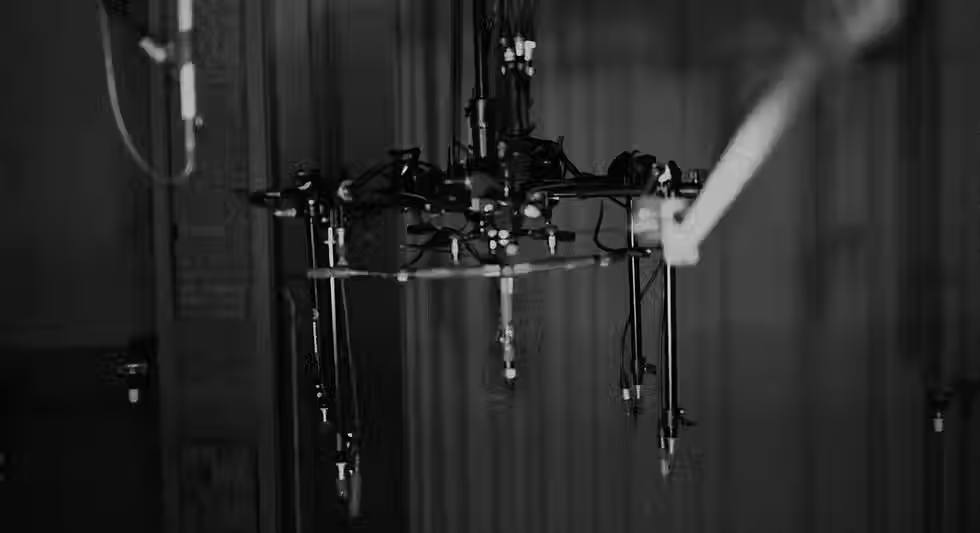
Microphone arrays that were used for recording two songs in two different room acoustics
"Drive With Me" // dry drum booth
"Crazy" // large studio hall
OCT-3D
Non-coincident
microphone array with 9 Sennheiser MKH 8000 series microphones (5.0.4)
Native B-Format
Coincident (Ambisonics)
with Schoeps MK2 and MK8 capsules
in a WXYZ setup
Ambisonics A-Format
Coincident (Ambisonics)
with the prosumer Sennheiser AMBEO, and several decoding options
IRT Cross
Near-coincident
four Sennheiser MKH 8040 microphones
in a quad setup (no height layer)
Abstract
A collection of test signals that are specifically tailored to current and future challenges in immersive audio listening formats on both speakers and headphones. As the human auditory system uses a combination of different techniques to localize sound, immersive audio reproduction systems should take these factors into account when their goal is to achieve accurate localization. The elements in these test signals were specifically selected to challenge the various aspects of sound localization, especially in musical applications, and can thus highlight any possible flaws in immersive sound reproduction systems. On top of that, some more practically oriented test signals are included, created to evaluate and calibrate the channel order and loudness of multichannel playback systems.
The four immersive test signals
Musical
8-bar immersive music loop with specifically chosen instruments to challenge auditory localization principles
Localization
Collection of localization tests to verify a playback system's localisation accuracy or for emperical research